Capability Statement Templates for Professional Impact
In the competitive landscape of government contracting and corporate partnerships, your first impression is often your only chance to stand out. A well-crafted capability statement is more than just a document; it's a strategic tool that communicates your company's value, expertise, and reliability at a glance. For many businesses, especially small to mid-sized enterprises, creating this document from scratch can be daunting. This is where professional, customizable templates become invaluable, transforming a complex task into a streamlined, professional outcome.
What Makes a Great Capability Statement Template?
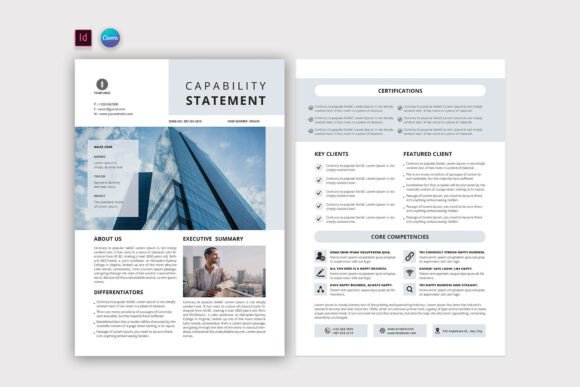
A superior capability statement template is defined by its clarity, structure, and visual professionalism. It’s not about flashy design, but about strategic communication. The best templates feature a clean, organized layout that guides the reader's eye naturally from your company overview to your core competencies, past performance, and differentiators. They use a balanced mix of typography and white space to ensure readability, whether viewed on a screen or printed. The personality of such a template is authoritative yet approachable, projecting confidence without overwhelming the viewer. It’s a design asset that acts as a silent ambassador for your brand identity.
The style leans towards modern typography, favoring clean sans-serif fonts for body text to maximize legibility, often paired with a slightly more distinctive serif or sans-serif for headings to establish hierarchy. The overall appeal is one of polished professionalism. It’s a document that feels intentional, trustworthy, and meticulously prepared—qualities that are crucial when submitting proposals for high-stakes projects. Think of it as the business equivalent of a sharp, well-tailored suit.
Practical Applications Across Industries
The utility of a well-designed capability statement extends far beyond a single use case. For businesses targeting government contracts, these templates are essential. They follow the expected format and include all required sections, ensuring compliance and making it easy for evaluators to find the information they need. In the corporate world, they are equally powerful for forming joint ventures, pitching to large prime contractors, or responding to Requests for Proposals (RFPs).
For creative professionals and agencies, the principle remains the same. While the content differs—highlighting creative services, portfolio samples, and design process—the need for a clear, compelling summary of capabilities is universal. A marketing agency, a web design studio, or a branding consultant can adapt these templates to showcase their unique offerings. The templates work best in contexts where credibility, past success, and a clear value proposition must be communicated efficiently. This includes:
- Government contracting and subcontracting (federal, state, local).
- Corporate partnership proposals and joint venture agreements.
- Competitive bidding for private sector projects.
- Sales enablement materials for business development teams.
- Investor pitch decks as a supplementary company overview.
Design Choices That Influence Perception
Every design element in a capability statement template contributes to how your business is perceived. The choice of font pairing, for instance, plays a subtle but significant role. A template that uses a strong, stable serif font for headings can convey tradition and reliability, which might appeal to engineering or construction firms. Conversely, a template using a sleek, geometric sans-serif throughout projects innovation and modernity, better suited for tech companies or digital marketing agencies.
Color is another critical factor. Professional templates often use a restrained palette—perhaps navy, charcoal, and white—to maintain a formal tone. However, customizable templates allow you to inject your brand's specific colors, ensuring consistency across all materials, from your website to your capability statement. This consistency strengthens brand recognition and reinforces your professional image. The visual hierarchy, achieved through thoughtful use of bold text, bullet points, and section breaks, ensures that key information like your NAICS codes, differentiators, and past performance highlights are immediately visible and digestible.
Choosing and Customizing Your Template
When selecting a capability statement template, consider the file format and your team's technical comfort. Formats like Adobe InDesign (INDD, IDML) offer maximum control over every design element, ideal for designers or those with access to the software. They are print-ready with proper bleeds and use CMYK color mode. More accessible formats, like those editable in Canva, provide a user-friendly, drag-and-drop interface perfect for entrepreneurs and small business owners who need to make quick updates without specialized software.
Evaluate the template's structure. Does it have dedicated sections for all the information you need to present? Look for clear areas for your company snapshot, core competencies, past performance, differentiators, and key data like CAGE and DUNS numbers. A good template will also include guidance, such as a PDF instructions file, explaining how to best utilize each section.
Finally, think about font pairings and readability. Even with a pre-designed template, test how your specific content looks. Ensure the body text is large enough to read comfortably, both on screen and in print. If the template uses a premium font, check if the license covers your intended use, especially for commercial projects. Many high-quality templates include links to download the free fonts used, simplifying the customization process. The goal is to end up with a document that not only looks professional but is also effortless for you to maintain and update as your company grows and wins new contracts.